 Aurigami
 collateral
Borrowing against eligible deposits in Aurigami, a lending protocol on Aurora, provides liquidity without selling the deposited holdings. Those deposits continue earning variable interest while backing the loan. Borrowing can fit a liquidity need when you can leave sufficient collateral committed and maintain room below the collateral-adjusted borrow limit as interest and asset prices change.
Article sections
Eligible assets and borrowing power
An enabled collateral asset contributes its protocol-valued balance multiplied by its collateral factor to the account’s borrowing capacity. A lower factor means a smaller share of the deposit’s value counts toward the limit.
| Asset | Documented collateral factor |
|---|---|
| USDC | 80% |
| USDT | 75% |
| WETH | 70% |
| WBTC | 60% |
| WNEAR | 60% |
| stNEAR | 40% |
| NEARX | 40% |
These are documented reference values; use the factor applied to the selected market when sizing a position. An asset also needs to qualify as collateral and be enabled for that account. Aurigami’s deposit guide locates the collateral setting under Deposit in My Account. Confirm its state and the resulting Borrow Limit before relying on a deposit for borrowing.
Available liquidity in the asset you want to borrow can restrict a loan below the account’s calculated capacity. Applicable market caps or pauses can also prevent borrowing.
Borrowing for liquidity or supplying for interest
A collateral-backed loan lets you retain a deposited holding while obtaining a supported borrowed asset. The commitment includes repayment in the borrowed asset: borrowing interest accumulates in that asset’s debt balance, while deposit interest is earned in the asset supplied. Different rates and asset values mean deposit earnings do not guarantee the borrowing cost is covered.
Supplying without borrowing can meet the simpler goal of earning deposit interest. It avoids creating a debt obligation against the deposit, although smart contract vulnerabilities and changes in the deposited asset’s value remain risks. If access to those funds matters more than obtaining another asset, leaving them uncommitted to a loan preserves greater withdrawal flexibility, subject to pool liquidity.
The published auToken implementation records increased debt and transfers the borrowed asset as part of a successful borrow. A submitted transaction alone does not establish that the loan completed.
Borrow Utilisation and liquidation
Account Borrow Utilisation measures valued debt against the collateral-adjusted borrow limit. Liquidation becomes possible when that ratio exceeds 100%. Because collateral factors reduce the value counted toward borrowing capacity, liquidation can become possible while the full market value of deposits still exceeds the debt.
Borrowing interest increases the amount owed. A fall in collateral prices or a rise in the value of the borrowed asset can also push utilisation higher. Borrowing below the maximum leaves room for those changes, but a sufficiently large move can exhaust it. Third-party liquidators can then repay debt and seize collateral under the protocol’s liquidation rules.
A USDC-backed borrowing calculation
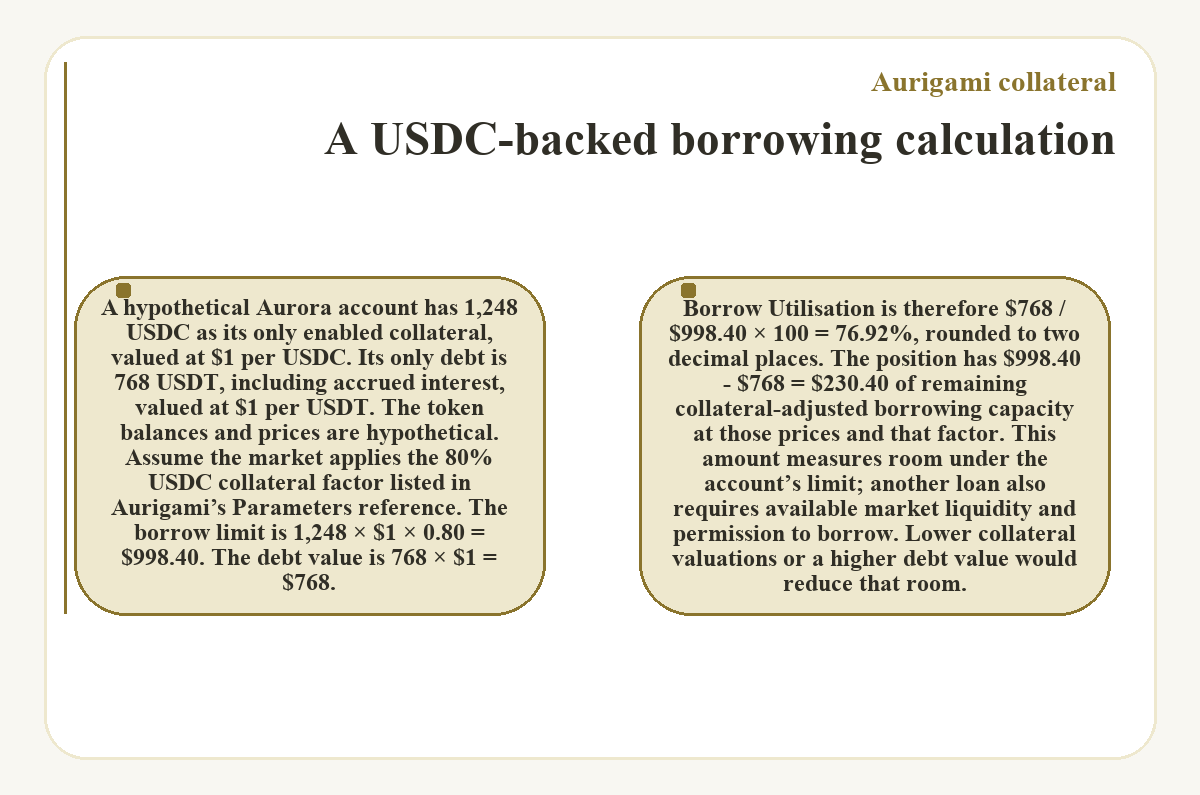
A hypothetical Aurora account has 1,248 USDC as its only enabled collateral, valued at $1 per USDC. Its only debt is 768 USDT, including accrued interest, valued at $1 per USDT. The token balances and prices are hypothetical. Assume the market applies the 80% USDC collateral factor listed in Aurigami’s Parameters reference.
The borrow limit is
1,248 × $1 × 0.80 = $998.40
. The debt value is
768 × $1 = $768
. Borrow Utilisation is therefore
$768 / $998.40 × 100 = 76.92%
, rounded to two decimal places.
The position has
$998.40 - $768 = $230.40
of remaining collateral-adjusted borrowing capacity at those prices and that factor. This amount measures room under the account’s limit; another loan also requires available market liquidity and permission to borrow. Lower collateral valuations or a higher debt value would reduce that room.
Reducing debt and releasing collateral
Repaying part or all of a loan reduces the debt obligation. Adding eligible, enabled collateral increases borrowing capacity while committing more assets to the position. Both can lower Borrow Utilisation, but they change different sides of the account’s collateral and debt calculation.
Aurigami’s deposit guide permits removing funds only when they are not needed for borrowing and their removal would not cause liquidation. Redemption also requires enough underlying cash in the relevant pool, as enforced by the published auToken implementation. If deposited assets are needed outside the protocol, reducing the loan first can release collateral; a positive borrowing margin alone does not guarantee an immediately executable withdrawal.
- last updated